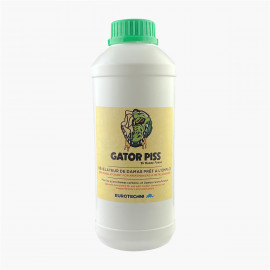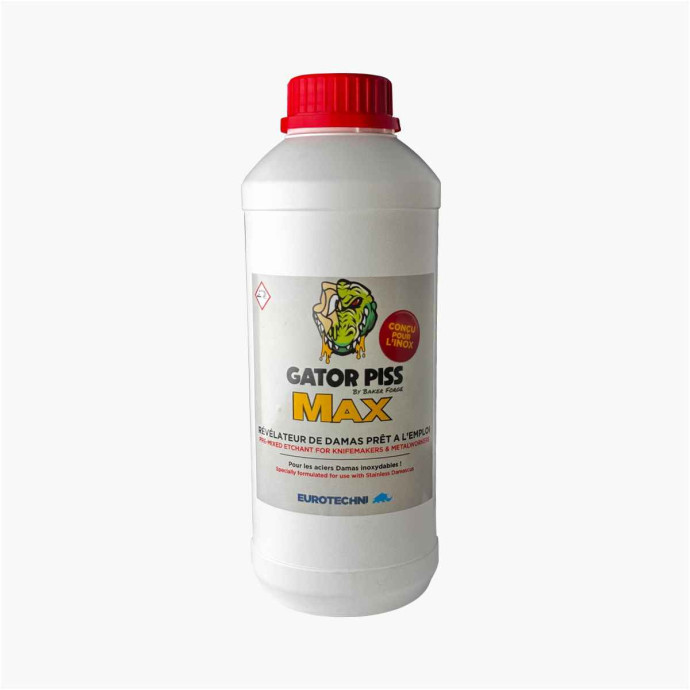





The ultimate solution for stainless Damascus. Delivers stunning, highly contrasted reveals with exceptional depth in a single application, without producing dangerous gas emissions. It simplifies the etching of stainless steels, achieving results comparable to those obtained with carbon steel.
Designed in the United States by Baker Forge.
In August 2022, Baker Forge partnered with Greyson Weltyk of Grey Blades to address a critical need within the knifemaking community: a reliable, no-mix Damascus etchant for pattern-welded and laminated steels.
The result was Gator Piss, a revolutionary product that streamlines the etching process, saves craftsmen time, and delivers consistent, high-quality finishes.
In 2024, in response to growing community demand, Baker Forge expanded the range with Gator Piss MAX, specifically developed for stainless steels to achieve deeper and bolder contrasts. With additional innovations currently in development, Baker Forge remains committed to providing cutting-edge products to knifemakers worldwide.
Instructions based on an ambient temperature of 18–23°C (64–73°F).
Finish the blade surface to be etched to at least 600 grit. We recommend 800–1000 grit for best results (the finer the grit, the brighter the finish). If you wish to darken a solid cutting edge, 600 grit is recommended.
Thoroughly degrease the blade.
Submerge the blade in GATOR PISS MAX. Monitor closely: if any streaking appears on the surface, immediately remove the blade and scrub it with a plastic-bristle brush. You may also repeat the first step if necessary.
If no streaking appears, leave the blade in GATOR PISS MAX for approximately 20 minutes.
Repeat the process as many times as necessary until the desired depth and contrast are achieved.
Note: To deepen the darkest areas, leave the blade in the solution for 20 minutes during each cycle. 3 to 4 baths may be required to achieve a deep black finish.
If certain areas do not etch properly, remove the blade from GATOR PISS MAX and neutralize it (for example, with soapy water). Polish the blade with a cloth buffing wheel or a fine-grit abrasive (2500 grit), then repeat the degreasing and etching steps.
Once the desired etch is achieved, remove the blade and neutralize it using soapy water or a mixture of water and baking soda.
Rinse thoroughly and apply oil (such as WD-40) to the blade.
Allow the oxides to “set” for at least 6 hours in a dry place before handling the steel again.
Oil and wipe down the etched piece.

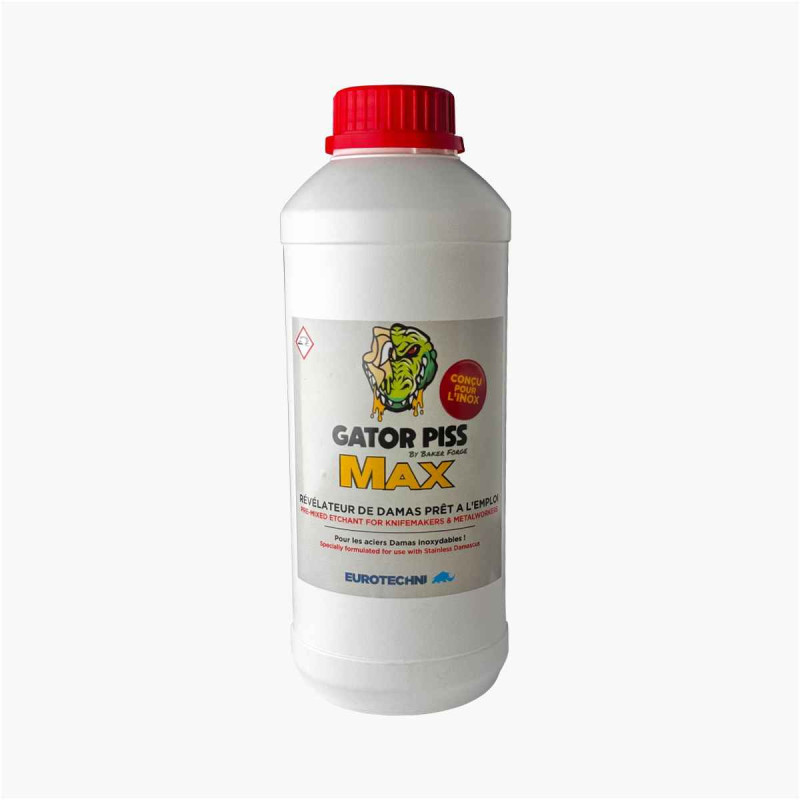
Gator Piss MAX cannot be shipped via DHL outside mainland France.